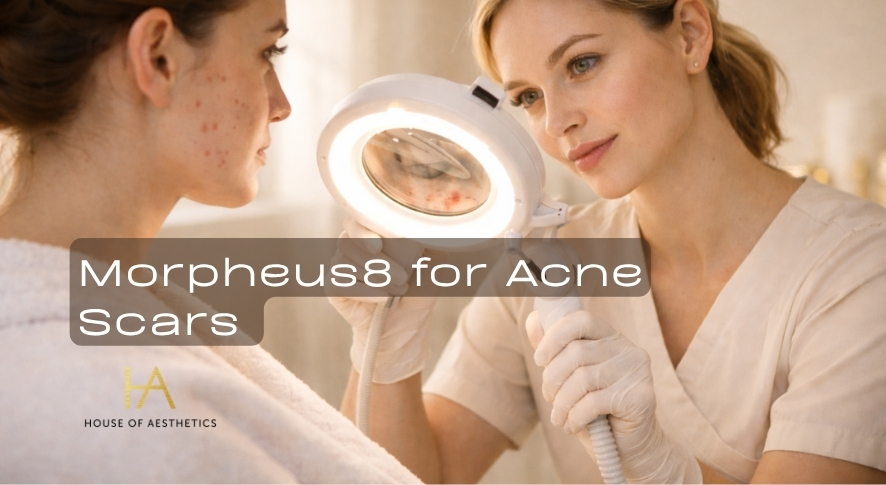
Morpheus8 for Acne Scars: How RF Microneedling Resurfaces Damaged Skin
Acne scars have a way of outlasting the breakouts that caused them. Long after the skin has cleared, the textural damage remains: shallow dips, deep pits, uneven patches that catch the light differently from the surrounding skin. If you have spent years trying serums, retinoids and surface treatments without meaningful change, it is worth understanding why those approaches struggle to reach where acne scarring actually sits.
The challenge is depth. Acne scars form in the dermis, the structural middle layer of skin where collagen has been damaged and poorly repaired. Treatments that work only on the surface, however good they are for tone and radiance, rarely address the root of the problem. That is why clinical treatments like microneedling, chemical peels and RF microneedling (Morpheus8) have become the go-to options for acne scar improvement.
This guide compares all three, explains what the clinical evidence says, and helps you understand which approach is most likely to work for your particular scars.
Understanding Acne Scars: Why They Form and Why They Persist
Acne scars are not simply marks left on the skin’s surface. They are structural changes within the dermis caused by the inflammatory healing process that follows a breakout. When a deep or inflamed lesion damages the collagen framework beneath the skin, the body’s repair response is imperfect. Instead of producing smooth, organised collagen, it lays down fibrous tissue in a rushed, haphazard pattern. The result is a visible scar.
The reason acne scars persist for years, even decades, is that the body does not revisit and correct this repair work on its own. Without intervention, the disrupted collagen structure remains as it was first laid down.
The Four Main Types of Acne Scarring
Not all acne scars behave the same way, and knowing which type you have is critical for choosing the right treatment.
Rolling scars are broad, shallow undulations that give the skin a wave-like appearance. They are caused by bands of fibrous tissue pulling the surface downward from beneath. These respond well to treatments that can disrupt the tethering and rebuild collagen support.
Boxcar scars are round or oval depressions with clearly defined vertical edges. Think of them as small craters with sharp sides. Shallow boxcar scars are treatable with most professional modalities, while deeper ones often need more aggressive intervention.
Ice pick scars are narrow, steep-walled pits that extend deep into the dermis. They are the most difficult type to treat because of their depth and small diameter. No single treatment resolves ice pick scars completely in most cases.
Hypertrophic scars are raised, firm areas where excess collagen has built up above the skin’s surface. These are less common with facial acne but do occur, particularly on the jawline and body.
The Three Treatments Compared
House of Aesthetics offers three distinct approaches to acne scar improvement: chemical peels, standard microneedling, and Morpheus8 RF microneedling. Each works at a different level and is suited to different scar severities.
Chemical Peels: Resurfacing from the Top Down
Chemical peels use controlled application of an acid solution to remove damaged outer skin layers. As the skin heals, fresher tissue replaces what was removed. At House of Aesthetics, we use BioRePeel and Tebiskin peels, which offer controlled exfoliation with minimal downtime.
How they work for acne scars: Superficial peels target the epidermis only. Medium-depth peels reach into the papillary dermis. This makes them effective at improving post-inflammatory hyperpigmentation (the dark marks left after a spot heals), smoothing minor textural irregularities, and giving the skin a more even, refined appearance.
Where chemical peels fall short: Because even medium-depth peels rarely penetrate beyond the papillary dermis, they have limited ability to restructure the deeper collagen damage that defines most atrophic acne scars. A study published in the Journal of Clinical and Aesthetic Dermatology compared microneedling to 35 per cent glycolic acid peels for acne scarring and found that 73 per cent of microneedling patients achieved significant improvement, compared to 33 per cent in the chemical peel group. Chemical peels are also associated with a higher risk of post-inflammatory hyperpigmentation in darker skin tones (Fitzpatrick IV to VI), which limits their suitability for a significant proportion of patients.
Best suited for: Mild, superficial scarring. Post-inflammatory discolouration. Overall skin texture refinement. Maintenance between deeper treatments. Chemical peels are also highly effective as a complementary step alongside microneedling; a 2025 systematic review and meta-analysis found that combining the two approximately doubled the odds of achieving 50 to 75 per cent clinical improvement compared to either treatment alone.
Standard Microneedling: Collagen Induction from Within
Microneedling uses a device fitted with fine, medical-grade needles to create controlled micro-injuries across the skin’s surface. These tiny punctures trigger the body’s wound-healing response, prompting new collagen and elastin production in the treatment area. At House of Aesthetics, we use the Dermapen and Imedpen devices, both of which offer precise, adjustable needle depth.
How it works for acne scars: By penetrating into the dermis, microneedling stimulates the fresh collagen production needed to fill in depressed scars and smooth out textural irregularities. The controlled injury also disrupts the fibrous bands that tether rolling scars downward. A meta-analysis published in the Journal of Population Therapeutics and Clinical Pharmacology found that microneedling demonstrated superior efficacy for atrophic acne scars compared to both chemical peels and laser treatments, with improvement maintained for up to 12 months.
Where standard microneedling reaches its limit: Standard microneedling relies on mechanical injury alone. The needles create channels and trigger healing, but they do not deliver thermal energy to the deeper dermal layers. This means the collagen remodelling response, while effective, is less intense and less deep than what RF-enhanced microneedling can achieve. For shallow rolling scars and mild boxcar scars, this may be sufficient. For deeper or more established scarring, the results can plateau.
Best suited for: Mild to moderate rolling and shallow boxcar scars. Patients seeking gradual improvement over multiple sessions. Those with darker skin tones who want to minimise hyperpigmentation risk (microneedling keeps the epidermis partially intact, offering a strong safety profile across all Fitzpatrick skin types). Budget-conscious patients looking for effective collagen induction at a lower price point than RF microneedling.
Morpheus8 RF Microneedling: Structural Remodelling at Depth
Morpheus8 combines the mechanical collagen induction of microneedling with radiofrequency (RF) energy delivered through gold-tipped, insulated needles. This dual mechanism is the key differentiator. While the needles create the same controlled micro-injuries as standard microneedling, the RF energy simultaneously heats the surrounding dermal tissue to a precise, controlled temperature. This thermal effect triggers a more intense wound-healing cascade, producing greater collagen contraction and more extensive neocollagenesis than mechanical injury alone.
How it works for acne scars: The Morpheus8 device penetrates to an adjustable depth of up to 4mm for facial treatments (and up to 7 to 8mm for body applications), reaching well into the reticular dermis where acne scar tissue originates. The RF energy delivered at depth does three things that standard microneedling cannot: it contracts existing collagen fibres for immediate tissue tightening, it triggers a more robust wave of new collagen production over the following months, and it remodels the disorganised scar tissue structure itself.
The clinical evidence supports this distinction. A 2025 retrospective review published in the Aesthetic Surgery Journal examined 356 patients treated with three different modalities for acne scarring. The Morpheus8 fractional RF microneedling group showed a relapse rate of just 24 per cent at three-year follow-up, compared to 67 per cent for the isotretinoin group and 75 per cent for the ablative laser group. The same study reported 50 to 70 per cent improvement in atrophic scar texture and depth after three sessions, with no severe side effects across all skin types (Fitzpatrick I to VI).
Separately, clinical trials using Global Aesthetic Improvement Scales report that approximately 85 per cent of RF microneedling patients rate their results as “very much improved” or “much improved”, with objective measurements showing a 25 to 35 per cent reduction in pore size alongside the scar improvement.
Best suited for: Moderate to severe acne scarring, including deeper rolling scars, boxcar scars and mixed scar types. Patients who have tried standard microneedling or peels without adequate improvement. Those seeking the most significant structural remodelling available without surgical intervention. All skin tones, including Fitzpatrick IV to VI, due to the insulated needle design that spares the epidermis.
How Each Treatment Compares: At a Glance
| Chemical Peels | Standard Microneedling | Morpheus8 RF Microneedling | |
|---|---|---|---|
| Depth of action | Epidermis to papillary dermis | Mid-dermis | Deep reticular dermis (up to 4mm facial) |
| Mechanism | Controlled chemical exfoliation | Mechanical collagen induction | Mechanical + RF thermal remodelling |
| Best scar types | PIH, mild texture | Shallow rolling, mild boxcar | Moderate-deep rolling, boxcar, mixed |
| Sessions typically needed | 3 to 6 | 3 to 6 | 3 to 4 |
| Session spacing | 2 to 4 weeks | 4 to 6 weeks | 4 to 6 weeks |
| Downtime | Minimal (1 to 3 days) | 2 to 3 days | 3 to 5 days |
| Results timeline | Visible within 1 to 2 weeks | 4 to 6 weeks, full results 3 months | 4 to 8 weeks, full results 3 to 6 months |
| Safe for darker skin tones | Caution required | Yes | Yes |
| Long-term durability | Requires regular maintenance | Up to 12 months | 24+ months (based on 3-year follow-up data) |
Which Treatment Is Right for Your Acne Scars?
The answer depends on three factors: the type and depth of your scarring, your skin tone, and your expectations.
If your main concern is discolouration and mild texture: Start with chemical peels. BioRePeel or Tebiskin peels are excellent at refining surface tone and addressing the dark or red marks that linger after acne has healed. These marks (post-inflammatory hyperpigmentation and post-inflammatory erythema) are not true scars but are often mistaken for them. Chemical peels address them effectively without the recovery time of deeper treatments.
If you have shallow, widespread scarring: Standard microneedling with Dermapen is a strong option. It offers meaningful collagen induction at a more accessible price point, with a well-established safety profile. For patients with darker skin tones, microneedling carries a lower risk of pigmentation disturbance than chemical peels or laser-based treatments.
If your scarring is moderate to severe, or you want the most structural change possible: Morpheus8 is the most clinically supported option for deep, lasting scar remodelling. The addition of RF energy enables treatment at depths that standard microneedling cannot reach, and the three-year follow-up data showing a 24 per cent relapse rate (compared to 75 per cent for laser) suggests that the collagen restructuring it produces is more durable.
If you are unsure: That is exactly what a consultation is for. Your practitioner will assess your scar type, skin tone, previous treatment history and goals before recommending a course of action. In many cases, a combination approach, for example starting with Morpheus8 for deep structural remodelling and maintaining results with periodic chemical peels, delivers the best long-term outcome.
What to Expect During Morpheus8 Treatment for Acne Scars
A topical anaesthetic cream is applied 30 to 45 minutes before treatment to ensure comfort. The Morpheus8 handpiece is then passed across the treatment area, with the practitioner adjusting needle depth and RF energy levels according to the scar type and location. Facial treatments typically take 30 to 45 minutes.
During treatment, most patients describe a deep warming sensation with mild pressure. The anaesthetic manages discomfort effectively for the vast majority of patients.
Afterwards, the skin will appear red and slightly swollen, similar to moderate sunburn. This typically settles within 3 to 5 days. Small pinpoint marks from the needles fade within the first 48 hours. Most patients return to normal activities, including work, within 2 to 3 days, though makeup should be avoided for the first 24 hours.
Results are not instant. The collagen remodelling process is gradual, with visible improvement beginning at around 4 to 8 weeks and continuing to develop for up to 6 months after each session. For acne scarring, 3 to 4 sessions spaced 4 to 6 weeks apart are typically recommended.
Important: Active Acne Must Be Controlled First
This point deserves emphasis. Morpheus8 (and standard microneedling) should only be performed on skin where active acne is fully under control. Treating active breakouts with microneedling of any kind risks spreading bacteria into surrounding tissue and worsening the condition. If you are still experiencing active acne alongside scarring, your practitioner will advise on a treatment pathway to resolve the active lesions first before addressing the scars.
Book Your Free Acne Scar Consultation
Every acne scar is different, and the right treatment depends on your skin, your scarring, and your goals. Book a free, no-obligation consultation at House of Aesthetics in Bromley to have your skin assessed by a qualified practitioner who can recommend the most effective approach for you.
Call us: 020 8290 0099 Visit us: 14 Market Square, Bromley BR1 1NA Book online: houseofaestheticslondon.com
The information in this article is for general educational purposes only and does not constitute medical advice. Individual results vary. All treatments are subject to a full in-person consultation with a qualified practitioner to assess suitability.