• Book Your Appointment
  • Buy Your Treatment Now
  • Offers
  • Price List
  • Team
  • Blog
  • Contact Us
Laser Tattoo Removal Explained How It Works, What It Costs, and What to Expect

Date

Laser Tattoo Removal Explained: How It Works, What It Costs, and What to Expect

Regretting a tattoo is far more common than most people think. Whether it’s a name that no longer belongs, a design that’s faded and blurred with age, or simply a piece that doesn’t fit who you are anymore, laser tattoo removal has become one of the most requested treatments in aesthetic medicine. If you’re considering it, you probably have a long list of questions: does it actually work, how many sessions will you need, will it hurt, and what does it cost. This guide walks through all of it, so you can go into a consultation feeling informed rather than guessing.

How Laser Tattoo Removal Actually Works

Tattoo ink sits in the dermis, the deeper layer of skin, where the body’s usual clean-up processes can’t easily reach it. Laser treatment changes that. The laser delivers short, high-intensity pulses of light that are absorbed by the ink particles. This causes the particles to heat rapidly and fracture into much smaller fragments, a process known as photo-acoustic breakdown. Once the ink is broken into pieces small enough, the body’s own lymphatic system gradually clears it away over the following weeks, and the tattoo fades a little more with each treatment.

According to North Bristol NHS Trust, Q-switched lasers use short bursts of energy absorbed by the tattoo particles, breaking up the pigment and its surrounding fibrous coating so the body can absorb it naturally. This targets the ink specifically, leaving the surrounding skin largely undisturbed.

The Technology Behind It: Q-Switched Laser

At House of Aesthetics, tattoo removal is carried out using the Lumenis M22 with Q-Switch Nd:YAG technology, a well-established platform in medical aesthetics. The Q-switched mode delivers extremely short, high-energy pulses that are absorbed by ink pigment rather than the surrounding tissue, which is what allows for controlled, targeted treatment rather than blanket skin damage.

This matters practically because darker inks such as black, navy, and deep red tend to respond well to this wavelength, while brighter colours such as yellow, green, and light purple absorb the laser energy less efficiently and typically need more patience to fade.

How Many Sessions Will You Need

This is one of the most common questions, and honestly, there’s no single answer that applies to everyone. The number of sessions depends on several factors working together: the ink colour and density, how deep the tattoo sits in the skin, whether it was done professionally or as an amateur piece, your skin type, and how your body responds to treatment between sessions.

Clinical guidance summarised by the Cheshire and Merseyside NHS notes that the number of sessions required is highly variable, generally falling somewhere between 12 and 16 sessions, though this can be fewer or as many as 20 depending on the tattoo itself. Amateur tattoos with less ink density often clear faster than professional pieces with heavier, layered ink.

During a consultation, your practitioner will assess your specific tattoo and give you a realistic estimate rather than a generic number, since guessing without seeing the tattoo rarely gives an accurate picture.

What Affects the Cost

Tattoo removal pricing isn’t one-size-fits-all, and a few key factors typically determine what you’ll pay:

  • Size of the tattoo: A small wrist piece costs less to treat per session than a full back design.
  • Ink density and colour: Heavily saturated or multi-coloured tattoos generally need more energy and more sessions.
  • Number of sessions required: Since removal happens gradually, total cost reflects the full course of treatment, not just one visit.
  • Location on the body: Areas with better circulation, such as the face and neck, tend to clear ink faster than areas like the ankles or feet.

Because of this variation, we don’t publish fixed prices for tattoo removal online. The most accurate way to understand your likely cost is a consultation, where your tattoo is assessed in person and you’re given a tailored treatment plan. Flexible payment options, including Klarna, are also available to help spread the cost of a treatment course.

What a Session Actually Feels Like

Most people describe the sensation as similar to a rubber band snapping repeatedly against the skin, sharp but brief. A topical numbing cream is typically applied beforehand to keep you comfortable throughout. Session length depends on the size of the tattoo, with smaller pieces taking just a few minutes and larger designs taking considerably longer.

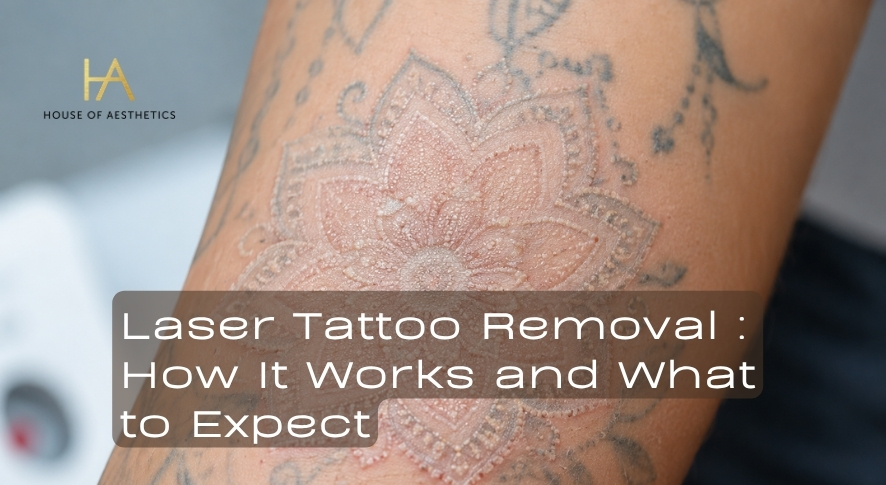
Immediately afterwards, it’s normal for the treated area to look red, slightly swollen, or to develop a pale “frosting” effect on the surface. This settles over the following days as part of the skin’s natural healing response.

Aftercare and the Healing Timeline

Between sessions, the skin needs time to properly clear away the fragmented ink and repair itself, which is why treatments are spaced several weeks apart rather than done back to back. During this period, keeping the area clean, protected from direct sun, and free from picking or scratching helps the skin heal cleanly and supports the best possible fading before the next session.

Sun protection is especially important, since treated skin is more sensitive to UV exposure while it heals, and the area can be prone to pigment changes if it’s exposed too soon.

Tattoo Removal and Skin Tone

Not all lasers are suitable for all skin tones, and this is one area where the choice of technology genuinely matters. Some older laser types carry a higher risk of pigment changes, particularly hyperpigmentation or hypopigmentation, in people with deeper skin tones.

This is part of why skin type is always assessed as part of a treatment plan, not an afterthought. A clinical review published in the Journal of the American Academy of Dermatology notes that Fitzpatrick skin type is one of the key patient factors dermatologists must account for when selecting laser settings, alongside tattoo colour, size, and history of scarring. That said, a proper in-person skin assessment is essential before any treatment plan is confirmed, since individual skin response can vary regardless of general safety profiles.

Why At-Home and DIY Removal Kits Carry Real Risk

It’s tempting to search for a faster or cheaper fix, and terms like at-home tattoo removal and DIY removal devices come up often. It’s worth being direct about this: there is no safe or effective way to remove a tattoo at home.

Laser tattoo removal is only safe and effective when carried out by a trained practitioner using properly calibrated, clinic-grade equipment. Devices marketed for home use aren’t subject to the same oversight, calibration, or safety controls as the equipment used in a licensed clinic, and incorrect use on skin can cause burns, permanent scarring, or uneven pigmentation that’s far harder to correct than the original tattoo.

If cost is the main concern, it’s worth discussing payment options at consultation rather than attempting a home solution that could end up costing more to fix later.

Who Might Need to Wait or Avoid Treatment For Now

Laser tattoo removal isn’t right for every situation, and a good clinic will always tell you this honestly rather than treating regardless. You may be advised to wait or explore other options if you’re pregnant or breastfeeding, have an active skin infection or condition in the treatment area, have recently tanned or spent significant time in the sun, or have certain underlying health conditions that affect skin healing. This is always assessed properly during a consultation, and your practitioner will talk through anything relevant to your individual health.

Frequently Asked Questions

Does laser tattoo removal completely remove a tattoo? In many cases, tattoos fade significantly or clear almost entirely, though full removal can’t be guaranteed for every tattoo. Ink colour, depth, and how your skin responds all play a part, and your practitioner will give you a realistic picture during consultation.

Is laser tattoo removal painful? Most people find it manageable, often describing it as a quick snapping sensation. Numbing cream is used to keep you comfortable throughout the session.

How far apart are sessions scheduled? Sessions are typically spaced several weeks apart to give the skin time to heal and allow the body to clear away broken-down ink naturally.

Can any tattoo be removed, regardless of colour? Darker inks such as black and navy tend to respond fastest to Q-switched technology. Brighter colours like yellow and green are more resistant and may take longer to fade.

Is it safe for darker skin tones? Q-switched Nd:YAG technology is considered a safer option for deeper skin tones compared with some older laser types, though a personal skin assessment is always carried out before treatment begins.

Can I get a new tattoo over an area that’s been treated? Once the skin has fully healed, this is often possible, though any remaining scar tissue may be discussed with you beforehand as it can affect how a new design sits.

Ready to Talk About Your Tattoo Removal Options?

Every tattoo is different, and the best way to understand your realistic timeline, treatment plan, and cost is a face-to-face consultation. Book a free consultation with House of Aesthetics London and let Nurse Prescriber Natalie assess your tattoo and talk you through a personalised plan.

Book your free consultation


This article is intended for general informational purposes only and does not constitute medical advice. Laser tattoo removal suitability varies from person to person, and results cannot be guaranteed. A full consultation and skin assessment with a qualified practitioner is required before any treatment plan is confirmed. If you have any underlying health conditions, are pregnant or breastfeeding, or have concerns about how this treatment may affect you, please discuss these with your practitioner before booking.

More
articles