Melasma, Sun Damage or Age Spots? Identifying Your Pigmentation Before Treating It
Dark patches on the face are not one condition. They are several, they behave differently, and they respond to entirely different treatments. That is the single most useful thing to understand before you spend money trying to fade them.
Melasma is hormonally driven and sits deep. Sun damage and age spots are cumulative UV damage and sit shallower. Post-inflammatory marks are the skin’s memory of a spot or a scratch. A treatment that clears one of these can visibly worsen another, which is why identifying what you actually have comes before choosing how to treat it.
This guide walks through how each type looks, what triggers it, and what that means for your options.
Why the Distinction Matters More Than the Treatment
Most people arrive at a clinic having already tried something. A brightening serum. A retinol. Sometimes a strong peel bought online. When it did not work, or when the patches came back darker, the assumption is usually that the product was not strong enough.
Often the real issue is that the treatment was designed for a different type of pigmentation.
Heat and light-based treatments are a good example. They work well on discrete, sun-induced spots because there is a defined target for the energy to break down. Applied to melasma, the same energy can act as a trigger, because melasma is a condition of overactive pigment cells that react to heat and inflammation as readily as they react to UV. This is the reason melasma has a reputation for rebounding.
So the first question at any consultation should not be which treatment you want. It should be what is actually on your skin.
Melasma: Hormonal, Symmetrical, Stubborn
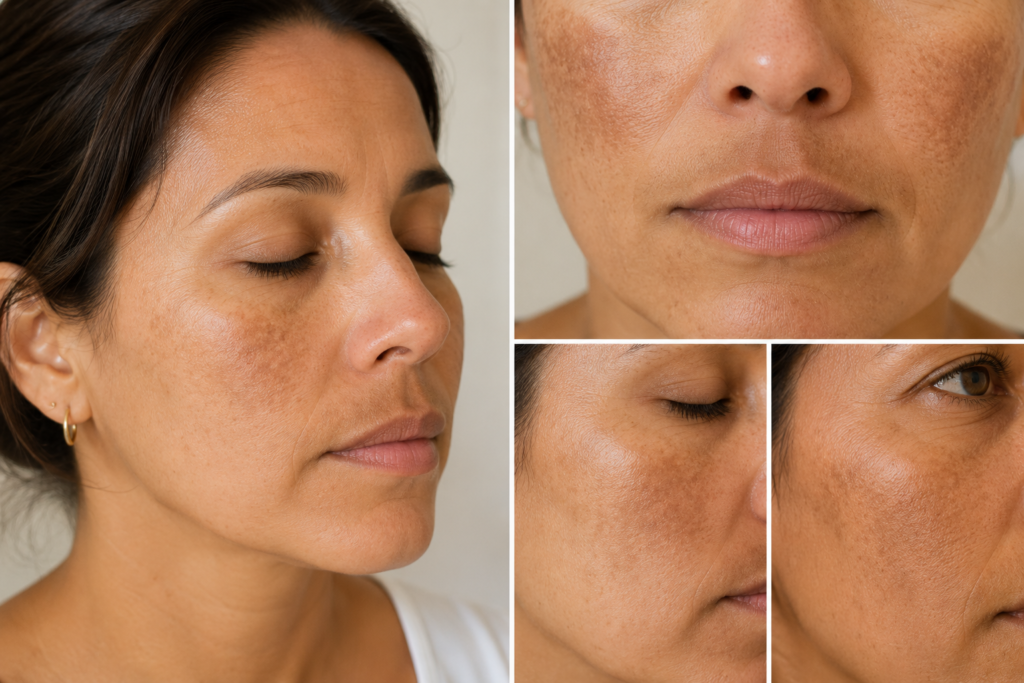
Melasma appears as brown or grey-brown patches with soft, irregular edges, almost always in a symmetrical pattern across the cheeks, forehead, upper lip, bridge of the nose or jawline. If you have a patch on one cheek and a mirror image on the other, that pattern is a strong clue.
It is overwhelmingly a condition of women in their reproductive years, and its triggers are hormonal as much as environmental. Roughly 10 to 20 per cent of women taking combined oral contraceptives develop it, and between 55 and 64 per cent of people with melasma have a family member who also has it. Pregnancy is the best known trigger of all, with reported prevalence during pregnancy ranging from around 36 per cent to 75 per cent, and up to 30 per cent of cases persisting long after delivery.
Heat matters too, independently of sunlight. Hot yoga, saunas, cooking over a hob and long-haul flights can all aggravate it.
The honest position on melasma is that it is managed rather than cured. The British Association of Dermatologists is clear that there is currently no cure, although several treatment options may improve the appearance, and melasma can return in a subsequent pregnancy. Anyone promising to eliminate it permanently is overselling. Results vary considerably between individuals.
How to recognise it: symmetrical, patchy rather than spotted, soft-edged, worse in summer, often started during pregnancy or after changing hormonal contraception.
Sun Damage and Age Spots: Discrete, Asymmetrical, Cumulative
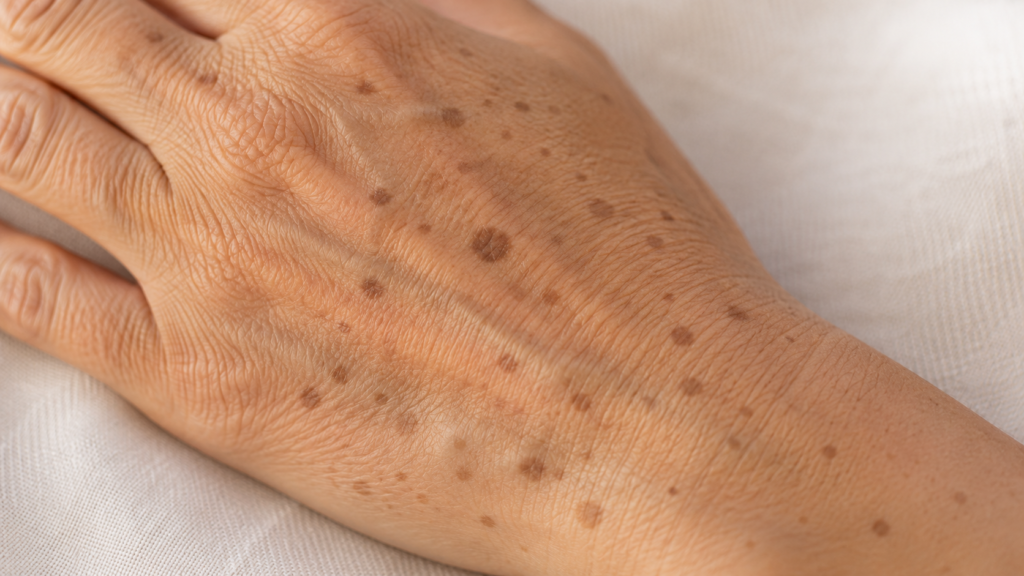
Solar lentigines, known variously as age spots, sun spots or liver spots, are the flat, well-defined brown marks that accumulate on the areas that have taken the most sunlight over a lifetime: the face, the backs of the hands, the forearms, the chest and the shoulders.
Unlike melasma, they are not symmetrical. They appear where the exposure happened, which is why the right side of the face and the back of the right hand often carry more of them in the UK, where that side sits nearest the car window. They are also extremely common with age, found in up to 90 per cent of lighter-skinned people over the age of 60.
A useful test is the seasonal one. Freckles fade noticeably over a British winter. Solar lentigines do not. They may darken slightly in summer, but they persist year-round, which is the clearest way to separate the two at home.
How to recognise it: individual spots rather than patches, sharply defined edges, scattered asymmetrically, on areas with a history of sun exposure, present all year.
Post-Inflammatory Hyperpigmentation: The Mark Left Behind
Post-inflammatory hyperpigmentation, or PIH, is not a pigment disorder in the way the other two are. It is a healing response. When skin is inflamed or injured, pigment cells can over-produce melanin in that exact spot, leaving a flat brown or grey mark once the original problem has resolved.
The giveaway is the shape. PIH takes the outline of whatever caused it. A round mark where a spot was. A line where a scratch was. A patch following the pattern of a rash.
It is far more common and more persistent in deeper skin tones. Fitzpatrick skin types III to VI are affected more frequently and more severely, with acne, atopic dermatitis and impetigo among the most common triggers. In one review of the evidence, acne-related PIH was documented in approximately 47 to 65 per cent of Black, Hispanic and Asian patients.
PIH will often fade on its own, but it can take many months or longer. The critical point is that treating the mark while the underlying inflammation is still active tends to produce more marks. Settle the acne or the eczema first, then address the pigment.
How to recognise it: the mark matches the shape and location of a previous spot, injury or rash, and appeared afterwards rather than gradually.
A Quick Comparison
| Melasma | Sun damage and age spots | Post-inflammatory marks | |
|---|---|---|---|
| Shape | Patches with soft edges | Distinct spots with defined edges | Follows the shape of the original spot or injury |
| Pattern | Symmetrical, both sides of the face | Scattered, asymmetrical | Wherever the inflammation was |
| Main driver | Hormones, UV and heat | Cumulative UV exposure | Acne, eczema, injury or a previous procedure |
| Typical onset | Reproductive years, often pregnancy | Builds gradually with age | Directly after skin inflammation |
| In winter | May soften but persists | Persists | Fades slowly over months |
| Key risk | Rebounds if treated too aggressively | Can be mistaken for something needing medical review | Recurs if the underlying cause is untreated |
Depth Changes Everything
Two people can have what looks like the same brown patch and need completely different treatment, because pigment can sit at different levels of the skin.
Pigment held in the upper layer, the epidermis, tends to be brown, sharply outlined and comparatively responsive. Pigment that has dropped into the deeper dermal layer looks greyer, hazier at the edges and is considerably harder to shift. Many cases of melasma are mixed, with pigment at both levels, which is why a course of treatment can lift part of a patch while the remainder appears to resist.
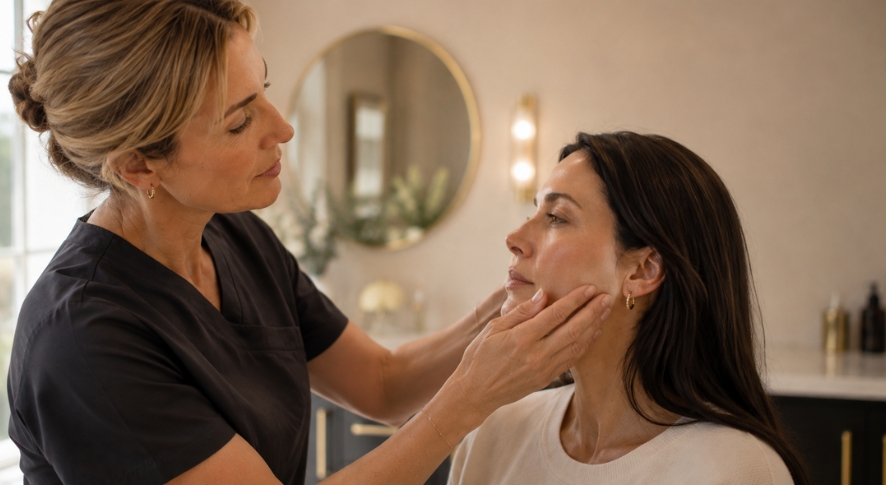
Depth is not something you can reliably judge in a mirror. It is assessed at consultation, and it is a large part of why an in-person skin analysis is worth doing before committing to a treatment plan.
When Pigmentation Needs a GP Rather Than a Clinic
This section matters more than any of the others.
Aesthetic treatment is appropriate for benign pigmentation. It is not appropriate for a mark that needs medical assessment, and no reputable clinic will treat one. Speak to your GP before booking anything if a mark:
- has changed in size, shape or colour
- has an uneven or ragged border, or more than one colour within it
- is itching, bleeding, crusting or has not healed
- is new and looks different from your other marks
- is growing, particularly if it is larger than 6mm
The NHS sets out the signs of melanoma and what to look for in a changing mole, and it is always worth a check. Having a mark assessed and cleared costs nothing and takes very little time. Treating something cosmetically that should have been reviewed medically can delay a diagnosis, which is a risk not worth taking for the sake of convenience.
A Word on Creams Bought Online
Hydroquinone is one of the most searched pigmentation ingredients in the UK, and one of the most misunderstood. It is prescription-only here. It is not permitted in cosmetic products sold over the counter, and enforcement against illegal skin lightening products remains active: Trading Standards has warned that items containing hydroquinone, mercury or potent corticosteroids continue to be sold unlawfully and can cause serious, sometimes irreversible harm.
If a cream promises dramatic lightening, arrives without a full ingredient list, or has no identifiable manufacturer, treat that as a reason to stop rather than a bargain. Prescription-strength pigmentation care should come through a prescriber who has assessed your skin, which at House of Aesthetics means Natalie, our Nurse Prescriber.
Matching the Treatment to the Type
Once the type and depth are established, the options become much clearer. Broadly:
For melasma, the approach is depigmentation and long-term suppression rather than removal. Our Cosmelan depigmentation peel works by reducing melanin production and is paired with structured home care, because melasma without ongoing maintenance tends to return. Aggressive light-based treatment is generally avoided.
For discrete sun damage and age spots, light-based treatment is well suited, because there is a defined target. We use the Lumenis Stellar M22 IPL for this, and it is worth being upfront that this treatment is most appropriate for Fitzpatrick skin types 1, 2 and 3. A course of around three sessions is typically recommended, though this varies with the extent of the damage and individual results may differ. You can read more on our pigmentation removal page.
For post-inflammatory marks, the priority is calming the original condition first. Where redness and flushing are part of the picture, that may point towards our rosacea treatment rather than a pigment-specific protocol.
Across all three, daily sun protection is not optional. The NHS advises a sunscreen of at least SPF 30 with at least four-star UVA protection, applied generously and reapplied through the day. Without it, any pigmentation treatment is working against a tide.
If you would like a deeper look at how Cosmelan works in practice, we have covered it separately in our guide to the Cosmelan peel. Treatment options and current pricing are listed on our price list, and a free consultation is the best way to get a personalised quote.
Frequently Asked Questions
How can I tell if I have melasma or sun damage? Look at the pattern. Melasma tends to form soft-edged patches in a symmetrical arrangement across both cheeks, the forehead or the upper lip, and it often begins during pregnancy or after a change in hormonal contraception. Sun damage produces individual, sharply defined spots scattered asymmetrically on areas that have had the most sun exposure. A consultation with skin analysis can confirm which you have and how deeply the pigment sits.
Does melasma ever go away completely? Melasma associated with pregnancy sometimes fades in the months after delivery, but for many people it is a long-term condition that is managed rather than cured. Treatment may improve the appearance considerably, though results vary and ongoing maintenance and sun protection are usually needed to hold those results.
Can IPL make pigmentation worse? It can, if it is used on the wrong type of pigmentation. Light and heat-based treatments suit discrete, sun-induced spots, but melasma is reactive to heat and can darken in response. This is precisely why identifying the type of pigmentation before treating it matters so much, and why we assess before recommending.
Why do dark marks keep appearing after my spots heal? That is post-inflammatory hyperpigmentation, which is more common and more persistent in deeper skin tones. Because it is a healing response to inflammation, new marks will continue to appear while the acne or eczema causing them is still active. Addressing the underlying condition first is more effective than treating each mark individually.
Is hyperpigmentation treated on the NHS? Pigmentation is generally regarded as a cosmetic concern rather than a medical one, so treatments such as peels and light-based therapies are rarely available through the NHS. Your GP can, however, review a mark you are unsure about, and may be able to discuss alternatives if a prescribed medication appears to be contributing.
How many sessions will I need? This depends entirely on the type of pigmentation, how deep it sits and how your skin responds. Some approaches involve a single application with a structured home care phase afterwards, while others are delivered as a course. We would give you a realistic range at consultation rather than a fixed number in advance.
Will my pigmentation come back? It may. Sun exposure, heat and hormonal changes can all trigger pigment production again, whichever treatment you have had. Consistent daily SPF and, for melasma, an ongoing maintenance routine are the most reliable ways to protect your results. Individual results may differ.
Book Your Free Consultation
If you have been treating pigmentation without much success, the most useful next step is finding out what type you actually have.
Book a free consultation at House of Aesthetics in Bromley and Natalie, our Nurse Prescriber, will assess your skin with our advanced skin analysis, explain what is driving your pigmentation, and set out the options that suit it. There is no obligation and no charge for the consultation.
Call us on 020 8290 0099, visit us at 14 Market Square, Bromley BR1 1NA, or book online.